Vibrations can tell you a lot about the condition of a machine. A change in vibration frequency can indicate that something is starting to wear or behave differently, giving you an opportunity to perform maintenance before the machine breaks down.
Traditionally, vibration sensors are used for this type of predictive maintenance. But they have their limitations. You may need several sensors to monitor different parts of a machine, and attaching a physical sensor to every component you want to measure isn't always practical.
This is where event-based vision offers an interesting alternative. With an event-based camera, you can measure vibrations without physical contact and monitor multiple points within the camera's field of view at the same time.
Let's take a closer look at how it works.
Measuring Vibrations Without Physical Contact
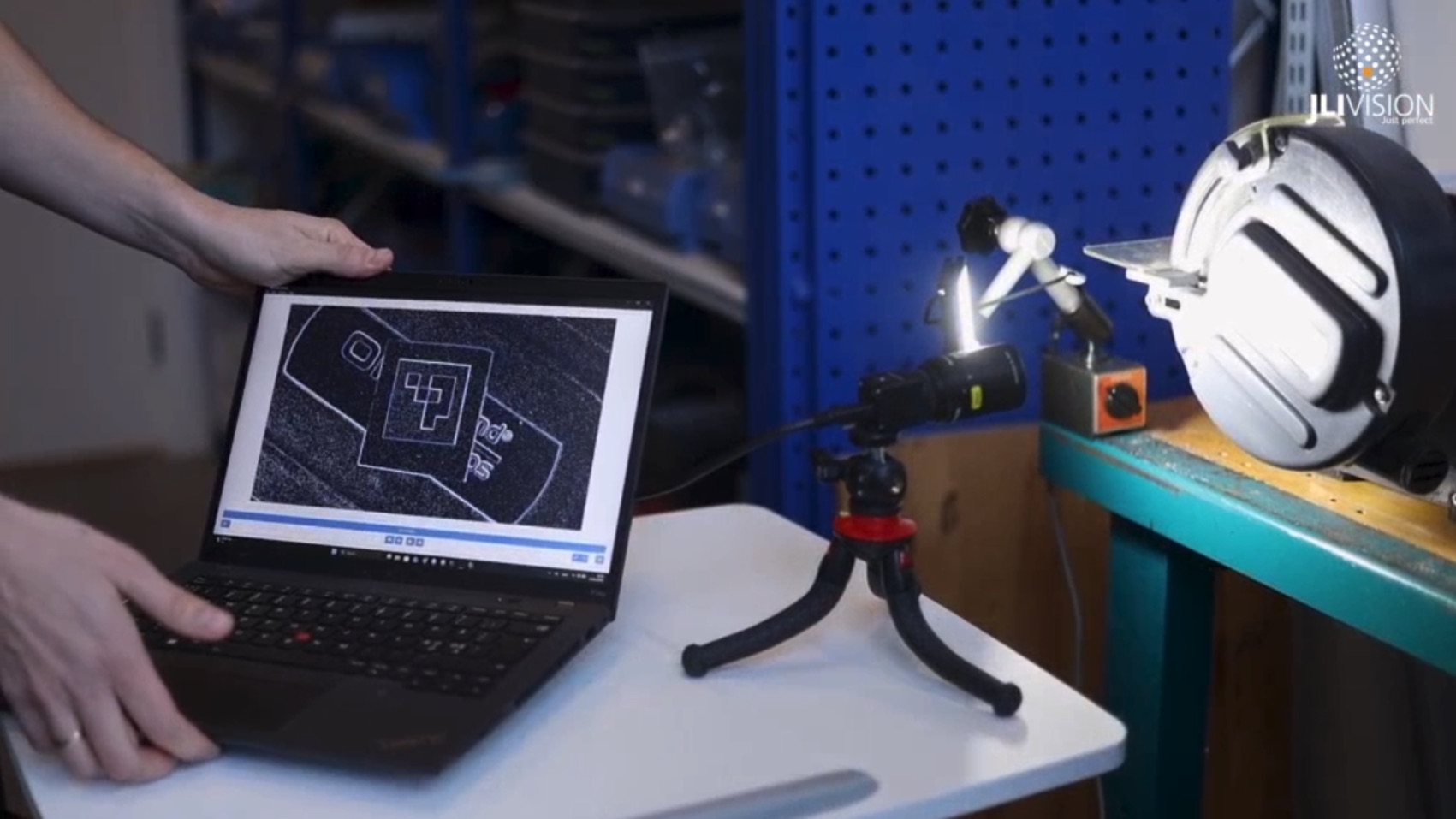
To measure vibrations with event-based vision, we place a marker on the machine at the point where we want to measure movement. Multiple markers can be placed within the camera's field of view, allowing us to perform several measurements with the same setup.
The event-based camera tracks changes in the scene with microsecond precision. By following the movement of each marker, we can calculate the vibration frequency and monitor how it develops over time.
At JLI, we test this principle using a motor-driven setup that creates vibrations similar to those found in actual production. This allows us to develop and test the solution under conditions that closely resemble the customer's operating environment.
Why Not Just Use a Regular Camera?
In principle, vibration measurements can also be made with a conventional camera. The problem is that conventional cameras capture complete images at fixed intervals.
If something moves between two frames, information about that movement is lost. Motion blur can also become an issue, and conventional cameras can be more challenged by very dark or very bright lighting conditions.
High-frequency vibrations make the challenge even greater.
To measure a given frequency, you need a frame rate of at least twice the frequency you want to measure. So, if you want to measure vibrations at 500 Hz, you need to analyze more than 1,000 images every second.
That requires a high-frame-rate camera and generates a huge amount of image data that needs to be processed.
Event-Based Cameras Only Record What Changes
An event-based camera works fundamentally differently.
Instead of continuously capturing complete frames, it records changes at individual pixels. When a change—or an "event"—occurs, the camera records the pixel coordinates together with a precise timestamp.
Everything in the scene that remains stationary is essentially ignored.
For vibration monitoring, this is a significant advantage. We are interested in the small movements of specific points on the machine, not thousands or millions of pixels showing a stationary background.
By removing that unnecessary information, the amount of data becomes significantly smaller while retaining the information we actually need. This makes it possible to analyze very fast movements and high vibration frequencies efficiently.
From Vibration Data to Predictive Maintenance
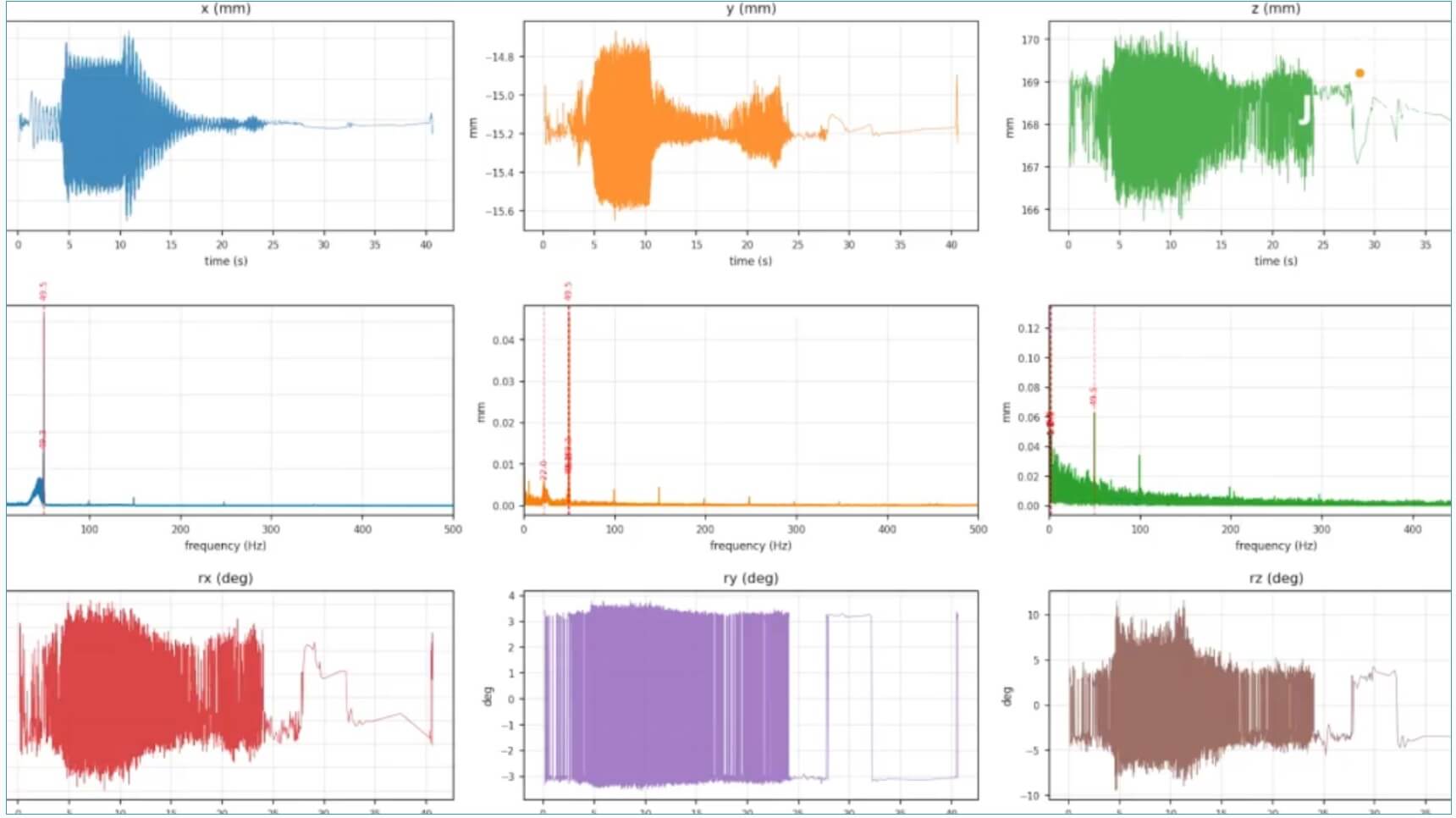
Capturing the vibration is only the first step. The events recorded by the camera are processed by an algorithm and can be translated into a frequency diagram showing the vibration frequencies in hertz.
Once we know what the normal vibration pattern of a machine looks like, we can monitor it for changes.
If a frequency peak begins to move, or additional peaks start appearing, it can indicate that something in the machine is changing. The system can then trigger an alarm, allowing maintenance teams to investigate the issue.
Instead of waiting for a component to fail and cause an unexpected production stop, you get an opportunity to react before the breakdown occurs.
One Camera, Multiple Measurements
Another advantage compared with traditional vibration sensors is the ability to monitor several locations at once.
With physical sensors, measuring vibrations at several points may require several individual sensors. With event-based vision, multiple markers can be monitored simultaneously as long as they are visible within the camera's field of view.
And because the measurement is contactless, the technology can also be used in applications where mounting a conventional vibration sensor is difficult or impossible.
A Different Approach to Machine Monitoring
Event-based vision is still an innovative technology, and vibration measurement is only one possible application. The same principle can also be applied to tasks such as high-speed counting and fluid monitoring.
For predictive maintenance, however, the combination of microsecond precision, low data volumes, contactless measurement, and the ability to monitor several points simultaneously makes the technology particularly interesting.
By continuously monitoring how a machine vibrates and reacting when its normal pattern changes, event-based vision can provide an early warning of developing problems—and give you time to perform maintenance before they result in an expensive production breakdown.

.jpeg)