Management by doing nothing
"If you don´t know what to do, you´re probably in the wrong company"
- Jørgen Læssøe
This is chapter 4 of the book about JLI vision, "Pushing boundaries".
If you visit JLI's office on a Thursday morning, you will witness the company's weekly meeting, where status and tasks for the week are discussed. On the surface, it will look like any other department meeting, as held in many companies across the country, but if you hang around for a while, you will notice that something is different.
No boss leads the discussion and concludes based on the input. Different employees contribute and speak on the points they are responsible for, and the group makes the decisions. Not that it is chaotic. The agenda is clear, the roles are defined, and minutes are taken. But the decision-making process is a joint effort.
"We have a new assignment—who has the time and desire to meet with the customer on Thursday?"
"Does anyone have any objections to hiring the new applicant?"
“We have found a new project management tool. May we take some time to examine it more closely and prepare a decision proposal?”
Perhaps not so unusual if you were a handful of employees, but when you are closer to 40 on the team, as with JLI, it is far from typical to have a flat organization like this. No managers, only self-managing specialists.
.jpg?width=800&height=400&name=Team%20JLI%20(2).jpg)
The whiteboard meeting on Thursday morning is the weekly focal point for status updates and planning new tasks. As the number of colleagues has grown to almost 40, JLI has introduced a structure that allows the most important topics to be covered without everyone having to report on what they are currently working on.
MDN
The whiteboard meeting is not a new invention at JLI, nor is the organizational structure. In fact, it is the result of a deliberate decision made by Jørgen Læssøe just a few years after the company's founding.
"I had an epiphany, I would almost call it. We had hired three people from Aalborg University for a big project, and before they started, I had spent days planning how we would do it, who would take care of which tasks, etc. But then we sat down and talked about it, and one of them spoke up and said, ‘We’ll do it this way and that way. I know about this, I’ll take care of it, you take care of that, and then we’ll have a meeting there and there. Suddenly, they were running the project themselves. I thought I was supposed to be the big manager and tell them how to do things. But instead, I retreated to my office, looked at my blank sheet of paper, and thought, "What the hell am I supposed to do now?"
The experience formed the foundation of Jørgen Læssøe's own management principle: MDN - management by doing nothing.
And although the term exudes Jørgen Læssøe's typical self-irony, it is no joke. The essence of MDN is not to do nothing, but to intervene just enough to give others the space to do what they are good at. And it is precisely this principle that has been crucial in attracting talented people and, not least, ensuring that they stayed, so that the company's overall knowledge and skills could accumulate over time.

In 2022, Jørgen Læssøe was nominated for Owner-Manager of the Year in the Capital Region in the category Trust & Talent.
A foundation of trust
Several employees have celebrated their 25th anniversaries at JLI, and, according to many of them, one element in particular has been crucial to the company culture: trust.
"Jørgen's trust in other people is enormous. He is a radio mechanic himself, but he has founded a company full of engineers, so he has always surrounded himself with people who were more knowledgeable than himself. There are two ways to deal with that. Either you bully them, or you do as Jørgen does and say, 'You know more about this than I do, so you decide. That trust in the fact that you are more skilled than I am, and therefore it is your decision, I believe, is fundamental. I have never seen a boss able to do that to such an extent," says Kenn Hansen.
This approach is put to the test when disagreements arise, but even then, there have been no hiccups.
"At one point, 15-20 years ago, we all agreed that we should hire a full-time salesperson. Everyone except Jørgen, who said he didn't believe in the idea. But if that's what we wanted, he accepted the decision. Of course, it turned out that he was right, and it ended up being one of the most expensive mistakes we've made in the company," says Kenn Hansen.
The freedom to decide for yourself
The organization is essentially self-managing, which means that you organize your own working hours. You get paid for the hours you work, so you have the freedom to adjust your workload to organize your life the way you want.
"During the nearly 30 years I have been with JLI, I have gone through a number of different phases in my personal life, which I don't think many companies are equally attentive to adapting to. Giving people the space to turn up the energy level a little or turn it down a little when that's what they need," says Henrik Birk.
The freedom to choose how you do your work is inextricably connected to responsibility. As an employee at JLI, you must take responsibility for doing something that adds value to the company.
"If I go to Jørgen with an idea that I think is brilliant, I don't usually get a lot of feedback or pushback. But he sits there and looks at me for a moment, and then he says, 'I think you should do that. ' And then it's up to me to get the idea off the ground within the company. Jørgen doesn’t take the lead for you. But he assesses his people and says, 'I believe in him. If he has a good idea, he's allowed to run with it. But I’m not going to carry it out. That’s up to the person who's passionate about the idea,'" says Kenn Hansen.
Nine 25-year anniversaries
So far, this freedom and trust have resulted in nine employees receiving a small silver moose as visible proof of their 25th anniversary at JLI.
For long periods, "resignation" has been a virtually unknown phenomenon. Although JLI grew from 12 to 37 employees between 2016 and 2024, there was only one resignation during that period.
As Jørgen Læssøe concludes:
"This must mean that, on average, people stay at JLI for around 160 years."
Vision engineer Loke K. Bager joined JLI in 2021, and according to him, the ability to retain employees is partly due to the flat and somewhat fluid organization.
“In many companies, if you want to do something different, you will probably have to apply for a position in another department or resign and find a completely different job. But here, it's a little more dynamic, and you can help define what you do. So you may stay in the same place, but you'll be doing something completely different than you were 10 years ago," he says.
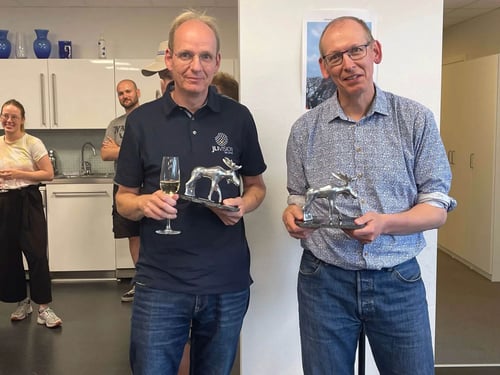
Morten Finnedal and Henrik Hegelund (on the right) have both celebrated their 30th anniversary at JLI.
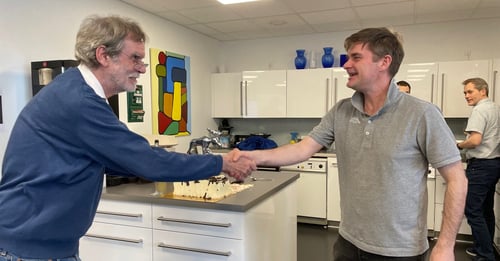
Esben Korre is one of nine JLI employees who received a small silver moose as visible proof of 25 years of service.
No one is a boss, so everyone is a boss
Making a flat, self-managing organization work is no easy task, especially when the workforce is growing rapidly. That is why JLI has been very conscious of nurturing and developing its culture. A tangible example of this is the close collaboration with business psychologist Henrik Kongsbak, who serves as a permanent sparring partner for JLI in its work to develop the structure to also support a payroll of 100 people.
"One of the first things we did was to establish that when no one is a boss, it means that everyone is a boss. You have to be able to make decisions yourself, and that requires a solid foundation, which is created through a high degree of transparency. Everyone in the company knows the pipeline, the development, the finances, and the problems. Otherwise, they cannot take responsibility for solving them," explains Henrik Kongsbak.
To equip employees to make decisions themselves, JLI uses a simple guideline: the consultation principle.
Basically, this means doing your homework, researching things thoroughly, and then asking yourself three questions:
- Does it create value for JLI (directly or indirectly) in relation to the cost?
- Would I do it if all my colleagues knew I was doing it?
- Would I think it was a good idea if one of my colleagues did it?
If you can answer yes to these questions, you are on safe ground.
The Kongsbak Group
JLI has created the "Kongsbak Group" as a forum where employees interested in contributing collaborate to find solutions to ongoing challenges.
How do you keep everyone updated when there are too many of you for everyone to take turns at a meeting?
How can knowledge best be shared?
How do you handle disputes?
How do you determine salary if there is no manager to negotiate salaries with?
The last question is an example of a topic that has been set aside for now. Salary negotiations are still handled by Jørgen Læssøe, as CEO. But the ambition is that, in the long term, this will be handled by the self-managing organization as well.
Hiring is already a joint effort, in that new applicants must speak with as many employees as possible during the process, and if one employee raises a red flag and opposes, the hire will not proceed.
A reversed business model
Creating a good workplace with maximum freedom has been a goal in itself, but according to Henrik Kongsbak, it has also indirectly contributed to the company's success.
"In a way, they have turned the business model upside down. Instead of pursuing specific growth targets, their ambition has been to create a cool place where talented people can do what they enjoy. And they have trusted that there would be a market for that, because the way they work means that they become the best. They have been quite conscious of this, but it is not a disguised growth strategy. It comes from a genuine place, from a passion for creating a different kind of workplace," he says.
Read chapter 5: Setbacks and an overdraft running dry
Or return to the table of contents.