CHAPTER 3 | PUSHING BOUNDARIES - THE STORY OF JLI VISION

The pioneers in the ragtag company

"There was a scrap yard around the corner, and I often went there to find bits and pieces, metal parts, or cables that we could use."

- Kenn Hansen 

This is chapter 3 of the book about JLI vision, "Pushing boundaries". 

"On my way out of the job interview, I walked past a test setup. The monkey cage, as it was called. A stand made of iron rods, assembled a bit like Meccano. There was a beer crate inside, and a camera and an old-fashioned spotlight of the kind you would have in your carport today were attached to it. Now, of course, it seems primitive, but I remember thinking it was incredibly exciting."

This is how Kenn Hansen, who in 1991 was captivated by the new technology that Jørgen Læssøe Ingeniørfirma was working with, became part of the growing engineering firm. 

A handful of engineers had gradually come on board. After spending the first few years in a 10-square-meter rented space at a company on Lyngby Hovedgade, where Jørgen Læssøe knew the owner, the company had now moved to Poppelgårdvej in Søborg. Here, the team had found premises in a red-brick building from the 1930s, offering more space for a growing vision company and its test setups. 

The premises resembled converted apartments and did not exactly constitute a glamorous backdrop. Denmark's largest printing press was located on the ground floor, and every time it printed a poster, the vibrations could be felt all the way up to the engineers on the third floor. The other half of the third floor was occupied by a company that produced shooting ranges for anti-terrorism corps. The owner had covered the partition wall with reinforced iron plates to test his equipment. So when it wasn't the printing press in the living room making noise, there were shots and the sound of projectiles being fired from the neighbor's place.

3Poppelgaardvej2

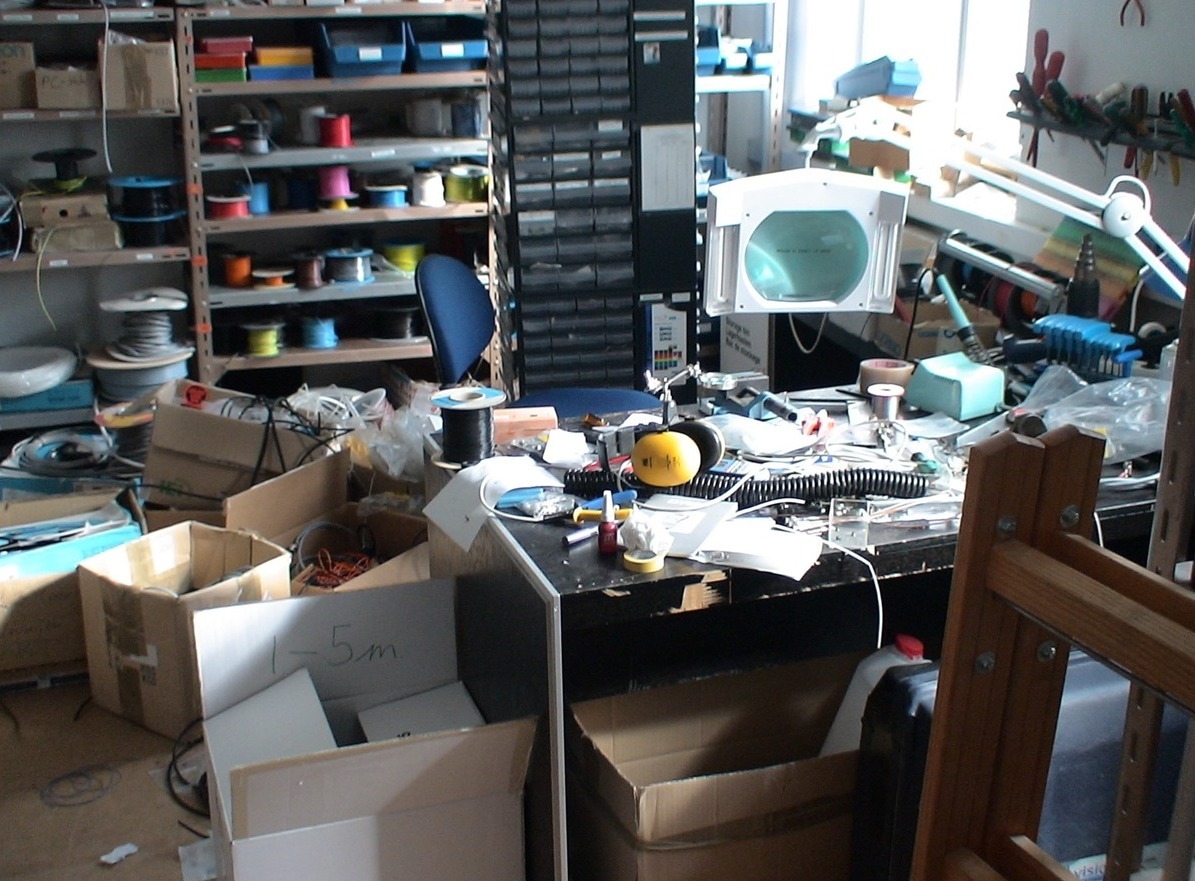
More time was spent devising innovative vision solutions than cleaning up the premises on Poppelgårdvej.

Bits and pieces everywhere

At the same time, the engineers were more occupied with making the next vision project a success than tidying up after themselves. Cables were strewn across the floor, shelves full of bits and pieces were all around, the desks were piled high with tools, and the office space was a curious mixture of workshop, laboratory, warehouse, and lunchroom.

Over time, JLI took over both the rest of the third floor and the first floor, but it never became truly presentable. 

"We had some large curtains that we could draw to cover the test setups if visitors came who weren't allowed to see what we were working on. It was a bit like Gyro Gearloose. We used what we had and made it work. It didn't always look very high-tech, but we managed with the resources we had," says sales manager Henrik Birk, who was hired in 1996.

sukker


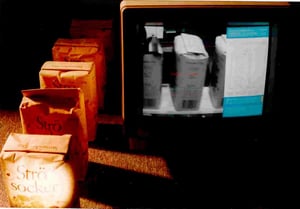
The closure of sugar bags and the curvature of cucumbers were two of the many diverse inspection tasks that Jørgen Læssøe Ingeniørfirma took on during its first few years.

Trained on the thigh of a Playboy model

The premises often reflected the tasks being worked on, says Jørgen Læssøe:

"We had a lot of sugar bags lying around because we had to inspect the closure to prevent the sugar from leaking, and we had an office full of cucumbers. We were hired by GASA in Odense to inspect cucumbers for curvature after the European Commission decided that cucumbers were not allowed to curve by more than 10 millimeters per 10 centimeters. So we created a system that could ensure that the most curved ones were sorted out. They ended up in a large bucket at the end of the sorting belt and were taken to the hippopotamus Maren at Odense Zoo."

"The worst thing, however, was when we had to sort pieces of ham by color so it could be put together to form a uniform ham. It was awful to have that ham lying around because we didn't have proper refrigeration facilities. It was a terrible mess. However, we had a Playboy calendar on the wall. There was a woman lying on the beach, and her thighs had exactly the shades we needed. So instead, we trained the system using the thigh of the Playboy model." 

3-playboymodel


When you don't have refrigeration facilities to store large quantities of ham for testing, you have to resort to alternative methods. Such as the thigh of a Playboy model, which happened to have all the right shades. 


At the scrap yard for supplies

The principle of utilizing the resources at hand also applied when new test setups had to be built.

"There was a scrap yard around the corner, and I often went there to find bits and pieces, metal parts, or cables we could use. It wasn't something you thought about; it was just the way it was. There was no big fancy company to compare it to. It was this or nothing," says Kenn Hansen.

The relatively humble surroundings and the down-to-earth approach to things have helped shape the company's self-image, which Jørgen Læssøe himself summed up when he described JLI as a basement workshop or a "ragtag company."

Arm wrestling with Danfoss

Behind the self-deprecating description, however, was a company that was far ahead of the field in vision solutions. Roughly speaking, there were two companies that made their mark in the field of vision in Denmark in the early 1990s. One, Danfoss Vision, due to its size; the other, due to Jørgen Læssøe's passion and the team's ability to devise innovative solutions. 

At times, the competition between the two companies was head-on. 

"In the early 1990s, Novo Nordisk came up with a big project that Danfoss also made a bid for. I had a chat with the purchaser, who was an engineer. I told him about our methods and how we could measure the injection syringes with much greater accuracy than required in the tender. He became interested in the principle of pixel integration, and to back it up, I said that I had recently given a presentation at a conference at British Steel, where I had reviewed the technology behind this method. I said I had a paper on it and would send it by mail. When I got back to the office, I wrote the paper. It wasn't presented at a British Steel conference, but it easily could have been," says Jørgen Læssøe. 

Much to Danfoss's regret, the assignment went to Jørgen Læssøe Ingeniørfirma.

"They called me 'Naughty Jørgen' at Danfoss in Aarhus. Shortly afterwards, Danfoss closed its vision department, and we later supplied equipment to the factory in Nordborg. We actually beat Jørgen Mads Clausen."

The order from Novo covered several projects for the inspection of insulin pens, and it became a milestone for JLI. Five new engineers were hired for the task, and it also marked the start of a close collaboration with the pharmaceutical giant. A collaboration that has grown in line with Novo's production and increasing need for inspection systems.

"I remember walking around in safety shoes and a helmet because there was no roof on the building yet when I went up to see the Novo factory in Hillerød where we were going to install the system. So we've really been there from the very beginning," says Kenn Hansen about the collaboration, which over time has accounted for a three-digit million amount of JLI's revenue.

Red-hot inspection

Jørgen Læssøe had numerous contacts from his time in England, which opened the door to the British market. At that time, most assignments were managed by agents, and initially, this resulted in work at the steel rolling mills at British Steel. 

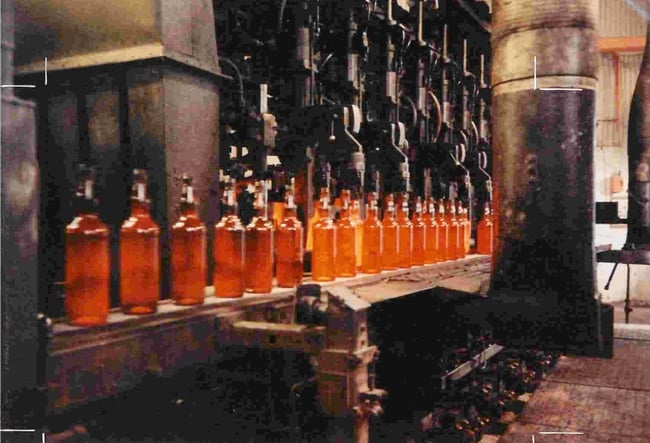
In the early 1990s, JLI developed the first inspection system for a glassworks in England. The system was designed to detect defects in glass bottles before they were cooled and tempered, preventing the loss of an hour and a half of production time dealing with defective bottles. The challenge was that the glass was 800 degrees Celsius after forming, making the production environment unsafe to work in. 

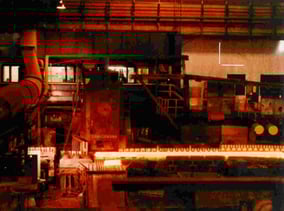
"A facility like this has to run continuously, and it is extremely hot and greasy. Building a vision system in that place was quite a challenge, and we only dared to bid on the job because we had solved tasks at steelworks, where we had proven that we could build camera housings that could survive those temperatures," says Kenn Hansen, who, together with Jørgen Læssøe, set up the system.

"Back then, there was no such thing as using a freight forwarder, so we loaded the entire system into the back of Jørgen's beat-up Ford Sierra, drove to Esbjerg, and took the ferry to Harwich." 
stålværk


The way into the British market was through the steelworks, to which JLI supplied a number of systems..


Showing off to the cleaning crew

A cage with protective glass had been installed at the production line at the glassworks, allowing you to quickly run out and adjust the machine if needed. 

"I remember standing there, excitedly bragging about it to everyone who came into the cage. Even the cleaning staff. I was probably more impressed than they were, but I thought it was amazing that it could be done," says Kenn Hansen.

Over the next few years, JLI carried out a number of projects in England, both at steelworks and glassworks, and in 1996, an English company, JLI Vision UK Ltd, was established to manage the English side of the business. JLI also rented a house that engineers could use when they went on installation trips to England. The English company operated for a few years, and for a period of time, almost half of JLI's revenue came from England. However, the strengthening of the British pound around the year 2000 made it difficult to export from England, which hit glass manufacturing companies hard. Within a year, almost all of JLI's business in England disappeared. 

flasker

Quality control of glass containers "at the hot end" made it possible to optimize production significantly. It was now possible to detect defects immediately after the glass was formed, instead of waiting half an hour for it to cool down.

From England to Thailand

However, the English connections had paved the way to new markets, as Jørgen Læssøe, through the English agent, made contact with a glassworks that produced fluorescent tubes. 

"No vision system had ever been made for fluorescent tubes before, so it was a ‘first in the world’ system, but we made it work. They bought 10 systems in a short period. The English steelworks had a technical collaboration with a Thai glassworks, which came by and saw the system. They wanted one too. So we went to Thailand and made some systems for them," he says.

The glassworks in Thailand collaborated with Japanese company Nippon Electric Glass. They heard about the inspection systems and invited JLI to Japan to hear more.

Jørgen Læssøe and vision engineer Henrik Hegelund traveled to Japan to discuss the task. 

"We could, in principle, build the system they needed. There was just one little detail: it had to be five times more sensitive than what we had delivered to Thailand, which was already the best in the world."

Japanese negotiation 

Jørgen Læssøe had studied Japanese negotiation techniques at home, so he knew that during negotiations, he should not respond immediately, but pause to appear thoughtful and never say no. This proved beneficial when the order was to be negotiated at the end of the meeting."The boss said, 'It's very interesting, Mr. Læssøe, but it's very expensive'. So I waited 20 seconds, thought it over, and then said that the system would be developed from scratch and would be the most efficient in the world. 

Long pause. 

'I still think it is very expensive,' he said.

So I had to respond in a way that would allow him to save face. I waited a moment and then said, 'It's very difficult, sir.' 

Another long pause. 

‘I understand you!’ he exclaimed, reaching across the table to shake my hand, and we had a deal.”

3Idasan

Jørgen Læssøe and his colleagues at JLI developed an unusually close working relationship with the Japanese company NEG, particularly through their relationship with Ida-san, an engineer responsible for the production of the thin glass tubes used for backlighting in flat screens. Normally, Japanese companies only traded through Japanese agents, but JLI was a direct supplier. One of the times Idasan visited JLI, he also got to take a ride in Jørgen Læssøe's private plane.

Flat screens for the people

The order was finalised, and now the system just had to be made. 

"We were used to inspecting ordinary fluorescent tubes, but these were fluorescent tubes for flat screens. They were 2 mm thin, and we had to find defects of 5 μm (5/1000 mm) on the tubes, which, in turn, were produced at a speed of 12 meters per second. It was really difficult, but we managed to build a system that they were very happy with, and they bought 30-40 systems over the following years," says Jørgen Læssøe. 

With the order, which was delivered to NEG in 2002, JLI helped bring flat screens into living rooms around the world. 

"Flat screens got off to a very slow start because it was difficult to create backlighting. So, in a way, I feel that we helped bring flat screens to market. Without our efforts, it could well have taken another year before others figured out how to solve the quality problem so that the glass tubes could be commercialized," says Jørgen Læssøe.

A few years later, LED light sources completely wiped out the market for inspecting fluorescent tubes for flat screens. However, the SK system, as the glass tube inspection solution is called, lived on and found a new lucrative niche in the pharmaceutical industry, where quality requirements are at least as high. The system has been extremely important for JLI's turnover, as it has been one of the relatively few systems that JLI has succeeded in reselling in large numbers, with a total of around 200 systems sold. 

3SK5


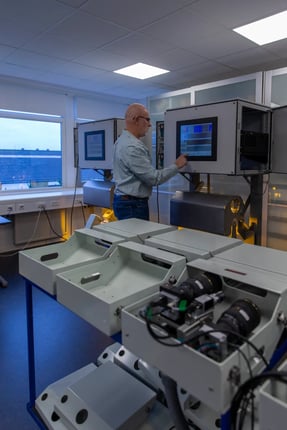
The SK system for inspecting glass tubes has been JLI's biggest seller. It is the system that has been resold the most times, up to 200.


Read chapter 4: Management by doing nothing

Or return to the table of contents.