"Is the image inside the computer?"
"Even though the image was blurred and skewed, with the right compensations and using a ruler as a reference, we were able to measure with 1/10 mm accuracy."
- Jørgen Læssøe
This is chapter 1 of the book about JLI vision, "Pushing boundaries".
It attracted a lot of attention that day at the computer exhibition at the Bella Center in 1981. Among the latest from Commodore and Apple, Jørgen Læssøe had set up a computer. It was connected to a TV camera, and with a press of the space bar, you could freeze the image on the computer screen.
He had brought the technology home the year before from Matrox in Canada, which had developed a 256x256 pixel image card and an A/D converter so that it could be connected to a tube camera. The computer was based on the Z80 with 64 kB of memory and used large floppy disks.
Jørgen Læssøe attached a match to the space bar to keep it held down, making the system continuously freeze new images on the screen.
The setup made people strike crazy poses and wave at the camera to see themselves reproduced in black and white on the screen, but it also sparked creativity among visitors in other ways.
At one point, an engineer from NKT, Ole Hansen, stopped by the booth.
"He asked if the image was stored in the computer, and I was able to confirm that it was. Then he asked if we could measure the geometry in the image. We could, because the computer could be programmed to measure the gray scale in each pixel. So if you took a picture of a nail, could you measure whether it was crooked or straight? It was an interesting idea, and I thought it could probably be done," says Jørgen Læssøe.
At that time, he worked for Jørgen Andersen Ingeniørfirma, which, in addition to selling its own video surveillance systems, also had international agencies for equipment in data and telecommunications, video, etc.

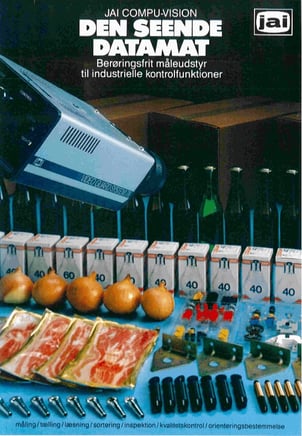
It was while he was employed at Jørgen Andersen Ingeniørfirma, that Jørgen Læssøe developed "Den seende datamat" (The Seeing Computer) and was put in charge of the company's Compu Vision Department.
Blurred and skewed images
After the exhibition, Ole Hansen contacted Jørgen Læssøe to ask whether he would conduct a preliminary study to confirm the project's viability. It was agreed, and Jørgen Læssøe threw himself into the project.
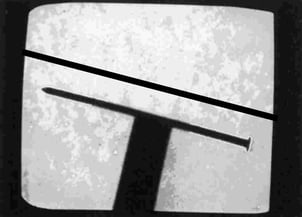
"This was before CCD cameras came along, so what we had at our disposal were tube cameras based on magnetic scanning. The images were neither stable nor geometrically correct, but I solved that by placing a metal ruler near the nail in front of the backlight and adjusting the optical center so that it was exactly between the nail and the ruler. The resolution was approximately 0.8 mm per pixel, and the pixels were clearly visible in the 256 x 256 format. Even though the image was blurred and skewed, with the right compensations and using the ruler as a reference, we were able to measure with 1/10 mm accuracy on a 130 mm nail," says Jørgen Læssøe.

Europe's first vision system was used for quality control of nails to ensure that they were straight and that the tip and head were intact.
NKT was convinced and asked for a quote for the system.
"A lot of calculations were made, and it was expensive. I think it was DKK 300,000, which was a lot of money back then. But they accepted the offer, and suddenly it was serious. I didn't have much experience with programming, but I hired a skilled programmer, Jesper Nilausen, who solved it in 14 days," says Jørgen Læssøe.
Jørgen Læssøe was actually trained as a radio mechanic and had only gotten halfway through his engineering studies, but he had nevertheless just developed something that had never been seen before. Europe's first computer vision system.
The seeing computer
The NKT project was both groundbreaking and extremely profitable, and several other projects followed. Jørgen Andersen Ingeniørfirma quickly recognized the technology's potential and established a development department to pursue it: the Compu Vision department.
Jørgen Læssøe was put in charge of the department tasked with developing "The Seeing Computer," as the innovation was called in marketing.
The projects ranged from measuring the fat and meat content in bacon when slicing to sorting recycled bottles and reading handwriting for the postal service.

"The seeing computer" became the marketing name for the new technology, which could inspect everything from bacon to bolts.
Pixel integration as a guiding principle
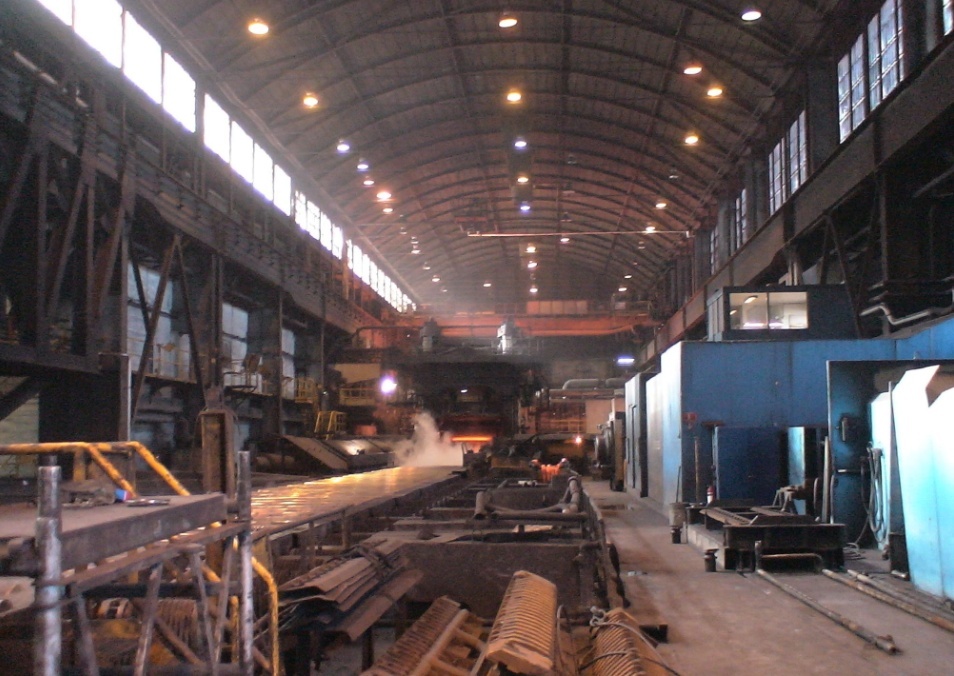
One of the particularly challenging tasks came from the Det Danske Stålvalseværk (Danish Steel Mill) in Frederiksværk. The steelworks wanted to measure the size of a red-hot slab before rolling it to minimize waste.
In the meantime, the industry had taken a technological giant leap forward with the introduction of CCD cameras.
"The first cameras I got were from Fairchild. We received prototypes 2 and 4. They were full of errors, dead pixels, and lines in the image, but the image was geometrically stable, which was fantastic in itself," says Jørgen Læssøe.
Due to the heat at the steelworks, the cameras were placed 15 meters above the red-hot slabs. This resulted in a pixel size of 10 cm, which in itself could not provide usable measurement accuracy. But here, Jørgen Læssøe introduced a principle that is still used in JLI vision today: pixel integration.
"If you integrate over a lot of measurement points in the image, you improve the resolution by the square root of the number of measurements. By taking 100 measurements, we were able to improve the measurement accuracy tenfold, bringing it down to 1 cm. That was quite astonishing with a pixel size of 10 cm. Pixel integration has been a fundamental principle in our measurement systems ever since, and it is the key to reliability. We never rely on a single pixel," says Jørgen Læssøe.
The system at Det Danske Stålvalseværk improved the accuracy of measuring red-hot slabs so much that the plant was able to record annual savings of DKK 16 million from reduced waste.

The vision system at Det Danske Stålvalseværk had to be placed 15 meters above the glowing slabs due to the intense heat.
"The possibilities are endless"
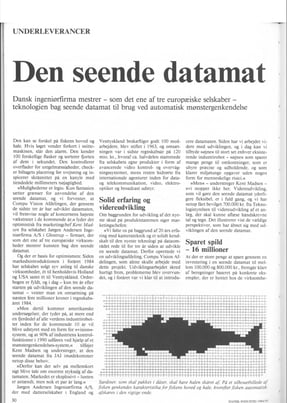
In an article in the Danish Industry Council's weekly newsletter in 1984, marketing manager Kent Madsen from Jørgen Andersen Ingeniørfirma talked about several successful projects. One of these was at Sanovo in Odense, where egg whites were separated from yolks. Here, a vision system improved the production plant's control function so much that production could be increased from 22,000 to 36,000 eggs per hour.
Kent Madsen had thus brought out the big words when he talked about the future prospects for the company in the article:
"The possibilities are endless. Only the imagination sets limits on the use of the seeing computer, and we expect that the Compu Vision Department, which has developed the computer over the past three years, will show some of the group's highest growth rates in the coming years."

Right from the start, there was great potential in using computer vision for quality control in industry, and the industry was predicted to have a bright future.
Read chapter 2: Jørgen Læssøe Ingeniørfirma
Or return to the table of contents.