First in the world
"We have always gone after the difficult tasks that others did not dare to take on"
- Jørgen Læssøe
This is chapter 7 of the book about JLI vision, "Pushing boundaries".
The foundations for JLI were laid when Jørgen Læssøe created Europe's first vision system, so innovation is practically encoded in the company's DNA.
But it's one thing to start at the forefront of the field, and quite another to stay there for 40 years. It requires a fine blend of curiosity and ambition, added to the fact that trivial tasks have never really been able to get Jørgen Læssøe out of his chair:
"We didn't want to do boring work, ordinary, simple vision work. We've always talked it down a bit. We've always gone for the difficult tasks that others didn't dare to take on. This may also be related to the fact that we haven't done any marketing, so people came to us themselves when they needed something difficult done."
Being able to call a system “first in the world” has become a badge of honor for JLI, even though this type of task involves greater risk.
"We have taken on many really difficult tasks, where we have also lost a lot of money. But it's research, and we've had fun with it, and it makes sense to us. When you get the really difficult tasks where you really have to do research, you can reuse elements and knowledge from them so that you are able to solve other difficult tasks later on," explains Jørgen Læssøe.
Quickly on to the next challenge
Although "first in the world" sounds appealing, JLI's focus on tackling the most difficult tasks has an obvious downside. It is rarely the first system that makes the most money. However, if you can conceptualize the solution and sell it again and again, a more attractive correlation emerges between revenue and the consumption of engineering hours.
JLI has not always excelled in this discipline.
"We haven't been very good at identifying the potential in the market and at selling and marketing. There has often been a new, exciting task that we have pursued," says Henrik Birk.
Until 2016, Jan Dall Christensen was able to observe JLI from the sidelines, and according to him, the challenge was that JLI had not fully realized the potential of the systems they were creating and a lack of focus on marketing and sales:
"They didn't consider that if we could sell five of these systems, we could probably sell more, and that we should pursue that when the market is there. And today, we look back at competing companies that have become big by selling something that JLI actually developed first, but simply didn't pursue."
400 years of accumulated experience
As an engineering company that thrives on devising new solutions, JLI's success stands or falls entirely on its employees' knowledge and experience.
This involves both in-depth knowledge of individual technologies and broad knowledge, as the company employs a large number of specialists with different areas of expertise. And then there is the almost invaluable experience of having seen so many solutions over time, so there is always something to draw on.
Therefore, the biggest threat to innovation is that this knowledge and experience will leave the company. Conversely, a unique competitive advantage arises when, like JLI, you have created a corporate culture that makes people want to stay.
"The business has benefited from the culture because it has meant that very few people have left. It is extremely important in a company like ours that the knowledge in people's heads remains in the company," says Henrik Birk.
Due to the many 25-year anniversaries and only a few resignations, JLI has accumulated more than 400 years of experience with machine vision, which few companies in the industry can match.
Trust and time
However, expertise and experience are only valuable if they are allowed to unfold, and this is where trust comes into play again.
"The fact that there is so much trust in people's ability to make the right decisions also means that people dare to try different things. If you want to develop solutions that break the mold, you have to dare to try something, even with the risk of failure. This is easier when you know that you won't have a disgruntled boss afterwards, but have full support," says Mia Kolsboe Hansen.
However, innovation does not happen by itself, which is why JLI makes a point of creating the right framework for it. Among other things, this means budgeting for 20 percent overcapacity among engineers so that a significant amount of time can be set aside for research and development.
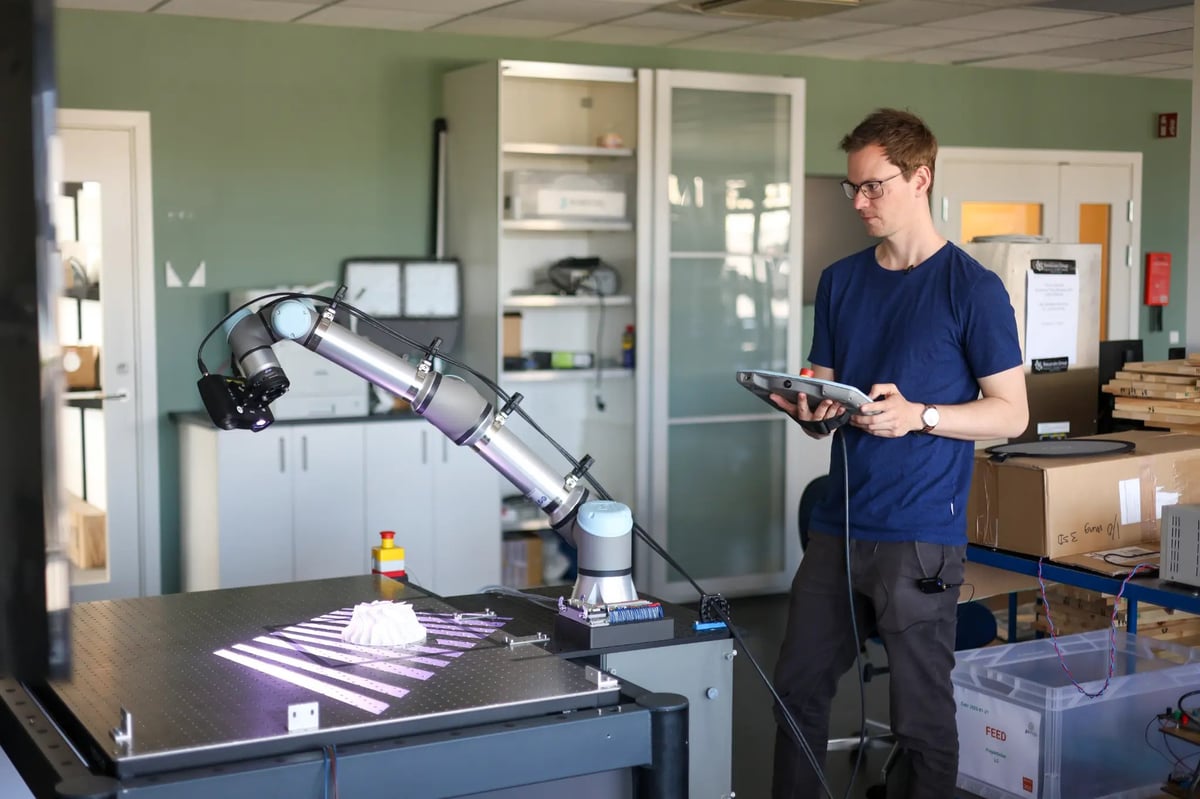
JLI has research groups in areas such as AI, hyperspectral imaging, and 3D. Here Loke K- Bager is woring on a 3D project.
The research is conducted within selected areas, where a group of engineers with a special interest in the field has taken on the task of ensuring that JLI is at the forefront and gathers and develops new knowledge. Among other things, there are research groups within AI, hyperspectral imaging, and 3D - areas that employees have agreed are important to focus on.
"There were people in the company who knew something about 3D, but there had been no organized effort to explore it, so a dedicated 3D group was formed. WWe focus on elevating JLI's capabilities and ensuring we possess the necessary expertise," says vision engineer Loke K. Bager, who joined the 3D group shortly after joining JLI in 2021.
He belongs to the "new generation" of employees who have brought up-to-date knowledge from university. Exectly this combination of fresh ideas and experience is essential for driving innovation.
"I think there is a sense of energy and drive every time new people arrive with a different perspective on things, and I believe this significantly contributes to supporting and future-proofing JLI," he remarks.," he says.
Martin Plenge Feidenhans'l, who joined JLI in 2023 after completing his PhD, agrees:
“One of the key factors that helps us stay innovative is our ability to bring in research assistants who introduce fresh knowledge for us to learn from. Within the research groups, we have the opportunity to apply that theory in practical ways,” he says.
Driving change yourself
Although JLI makes great efforts to create the framework for innovation, it is important to note that the success depends on employees' own drive. If you have a good idea for something you want to change or develop, you have to take the initiative yourself.
One example is JLI's "Annotator," a self-developed tool for annotating images for training AI models, which vision engineer Mads Lyngsaae has been the driving force behind.
"You have to make sure you take the time you need. No project manager is going to come along and push it forward. If you want to introduce something, you have to drive it yourself," says Mads Lyngsaae, who in turn has had the opportunity to put his own mark on the tool.
"It has become a mixture of what I thought would be cool and what I saw was needed across different projects. It has become a bit of a hobby project that has been of great value to JLI. I love making it better, so when someone gives me feedback on it, I rush to incorporate it," he says.

If you want something introduced, you have to drive it yourself. That's what Mads Lyngsaae did in developing JLI's annotation tool, "Annotator."
Read chapter 8: AI that works in real life
Or return to the table of contents.