Inline Box Inspection System | JLI vision
The Box Inspection system is an inline vision solution installed in packaging lines to verify carton geometry, flap closure, printed text, labels, and barcodes to avoid defective packages.
Case Summary
Packaging operations require methods to inspect carton geometry and printed markings directly on the line. JLI designs custom vision systems for packaging lines, including medical device applications, to evaluate box squareness, flap positioning, text, barcodes, and labels. Connecting directly to the line PLC, the system identifies defective packages during production.
The Challenge: Ensuring Box Geometry and Label Accuracy in Medical Packaging
Packaging lines must verify physical package assembly and print accuracy to avoid defective units. Cartons moving through secondary packaging can develop geometric defects such as skewed squareness or open flaps that compromise package integrity.
Manual in-process control leaves products between sample intervals unverified. Unchecked geometric flaws, missing labels, or unreadable barcodes can result in defective packages passing downstream.
Inspection systems must evaluate carton dimensions, check flap closure, and verify printed text, labels, or barcodes. Accommodating varied box sizes across production environments requires an adaptable vision design.
The Solution: Automated Multi-Point Packaging Verification
JLI provides individually designed vision solutions integrated directly into existing lines or packaging lines for medical devices. The setup uses 2D vision, 3D vision, or standard platforms such as Cognex vision depending on customer requirements.
The system combines dimensional gauging and print inspection to assess package squareness, flap positions, printed text, labels, and barcodes. Optical configurations are engineered individually to suit the dimensions and features of the specific boxes.
Integration into the production line allows the system to verify passing packages directly on the line. Connected to the machine PLC via digital I/O and Ethernet, the vision system communicates inspection results for line control.
How the System Works
The system inspects cartons inline as they move through the packaging line. Optical sensors capture 2D and 3D data of each passing package to evaluate geometry and surface markings. Inspection results are processed and transmitted to the line controller for handling.
- Part triggering: An inline sensor or line signal initiates image acquisition as the carton enters the inspection zone.
- Image capture: 2D and 3D vision sensors acquire images of the passing box.
- Geometric analysis: Software evaluates box geometry, measures squareness, and checks flap closure.
- Print inspection: Optical algorithms verify printed text, inspect labels, and decode barcodes.
- PLC communication: Pass or fail signals and data are transmitted to the PLC via digital I/O and Ethernet.
- Defect handling: The packaging line uses the inspection output from the PLC to manage defective packages.
Key Results and Operational Value
Installing an inline box inspection system helps packaging operations avoid defective packages. Continuous verification checks geometry, flaps, and print markings directly on the line.
Automating carton and print verification replaces sampling-based in-process control with inline monitoring. Transmitting inspection data directly to the line PLC allows the production line to track quality and handle defective cartons.
When a Similar System is Relevant
Investing in box inspection is relevant for packaging operations where defective cartons must be prevented from moving downstream. Automated inspection applies to packaging lines across various industrial and medical device environments.
The system is suitable for existing packaging lines requiring automated verification of carton structure, flap sealing, and printed information.
- Carton geometry checks: Lines requiring automated verification of box squareness and flap closure.
- Print and label verification: Operations needing inline inspection of text, labels, and barcodes.
- Medical device packaging: Packaging lines requiring verification of carton assembly and markings.
- Defect prevention: Facilities seeking to avoid defective packages in downstream handling.
Technical Capabilities
- PLC interface: Connected to the line PLC via digital I/O and Ethernet for signal exchange and data communication.
- Vision hardware: Built with 2D vision, 3D vision, or standard platforms such as Cognex vision systems.
- Custom design: Individual optical and mechanical design adapted to specific package sizes and line layouts.
- Print inspection: Integrated optical verification of printed text, applied labels, and barcodes.
- Environment compatibility: Designed for installation in any production environment, including medical device lines.
Features Inspected & Data Used
- Box squareness: Angular geometry and dimensional squareness of packages and boxes.
- Flap closure: Physical flap position to detect open or misaligned carton flaps.
- Applied labels: Presence, position, and alignment of packaging labels.
- Barcodes: 1D and 2D barcode reading and verification against product requirements.
- Printed text: Presence and legibility of printed alphanumeric text and markings.
Core Technologies Used
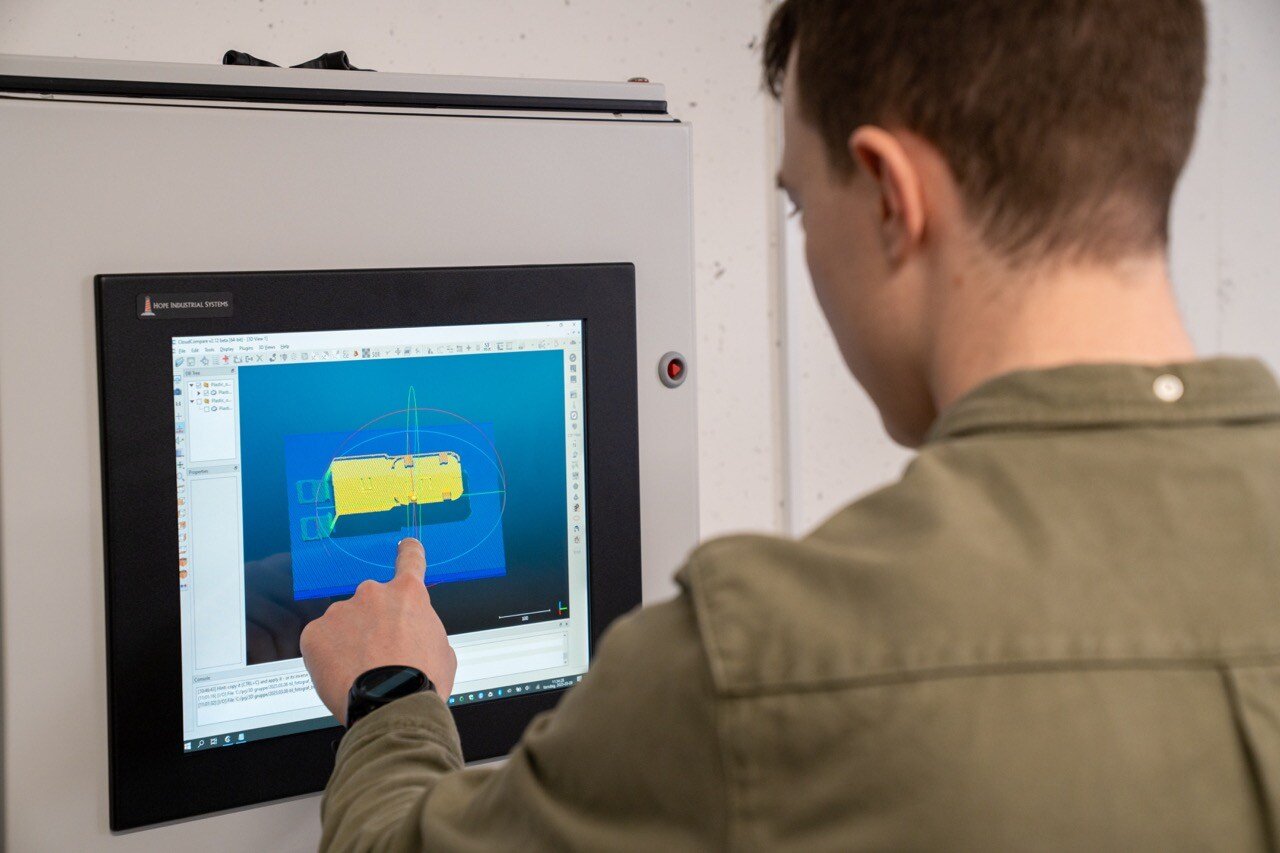
- 2D vision: Optical imaging for verifying surface markings, labels, text, and barcodes.
- 3D vision: Spatial measurement for evaluating carton geometry, squareness, and flap alignment.
- Print inspection: Software tools for verifying printed text, labels, and barcode data.
- Standard vision platforms: System integration utilizing Cognex vision or dedicated vision hardware.
- Industrial communication: Digital I/O and Ethernet interfaces for communication with line PLCs.
Frequently Asked Questions
What specific defect types can the box inspection system detect?
The system detects box geometry defects, including out-of-square packages and open or misaligned flaps. It also inspects packaging print to identify errors in text, missing or misplaced labels, and unreadable barcodes.
How does the vision system integrate with existing production line PLCs?
The vision system connects to the machine PLC using digital I/O and Ethernet. This interface allows the system to receive trigger signals, return pass or fail decisions, and share data with the line controller.
Can the inspection system handle varying carton dimensions on the same line?
The system is designed individually based on customer requirements and package dimensions. Optical setups and inspection software parameters are tailored to accommodate the required box sizes.
Which production environments are suitable for this packaging inspection setup?
The system can be designed for any production environment. It is typically installed directly into existing packaging lines or on packaging lines for medical devices.
Other inspection systems by JLI vision:

Discuss Your Inspection Challenge
Contact JLI vision to discuss packaging inspection requirements, review carton specifications, and evaluate an individual vision design for your packaging line.
Send me an email at hb@jlivision.com
or book a meeting, and let's find out how we can help you.